.svg)

USDA Loan Assumption: How to Take Over a Seller's Mortgage
Yes, USDA loans are assumable under 7 CFR 3555.256: qualified buyers keep a rate no higher than the seller's, with lender and USDA approval, saving about $713 a month versus a new 7.28% mortgage; family transfers skip eligibility review.
Key takeaways
USDA Loan Assumption: How to Take Over a Seller's USDA Mortgage
Executive Summary
- Direct answer: Yes, USDA loans are assumable. Under 7 CFR Part 3555 and USDA Handbook HB-1-3555, Chapter 17, a qualified buyer can take over a seller's existing USDA mortgage, keeping the remaining balance and an interest rate that by regulation cannot exceed the original loan's rate. Both the lender and USDA must approve the transfer for standard assumptions.
- Key insight: With the 30-year fixed rate at 7.28% on October 1, 2026, roughly 4 in 10 outstanding mortgages nationwide still carry a rate below 4%. A buyer who assumes a 3.15% USDA loan on a $280,000 balance saves approximately $713 per month compared to originating a new loan at today's rates.
- Assumable.io perspective: We built Assumable.io, the first national marketplace for assumable mortgages, because the mechanics of USDA assumption are frequently misunderstood even by real estate professionals, which is exactly the gap that drove demand for purpose-built tools and education in this space.
- Actionable takeaway: Before signing a new mortgage at 6.5% or higher, check whether the property you want carries an existing USDA loan. If it does, run the assumption math. Even with equity gap financing at current rates, the blended cost is typically thousands of dollars per year less than a new first mortgage.
A buyer shopping for a home in a USDA-eligible area gets quoted 7.28% on a new 30-year fixed mortgage. The monthly principal and interest on $280,000 comes to roughly $1,916. That same buyer discovers the seller's existing USDA mortgage carries a 3.15% rate with $280,000 remaining. The payment: about $1,203. That $713 monthly gap is not a hypothetical. It is the difference between assuming an existing loan and originating a new one. USDA loan assumption is a federally authorized but chronically under-explored path to below-market homeownership that rural and suburban buyers should understand before they sign anything.
What Is a USDA Loan Assumption?
A loan assumption means you take over the seller's existing mortgage rather than applying for a brand-new loan. You step into their loan with its remaining balance, remaining term, and contractual terms. You take on the debt, but on a USDA Guaranteed loan the seller stays personally liable on the original note even after the assumption is approved, under 7 CFR 3555.256.
This is not a workaround or a gray-area strategy. USDA loan assumptions are governed by 7 CFR Part 3555 and USDA Handbook HB-1-3555, Chapter 17. The handbook states explicitly: "Servicers must obtain approval from the Agency before consenting to a transfer with an assumption of the outstanding debt." Both the Guaranteed (Section 502) and Direct loan programs permit assumptions under their respective regulations.
A Large, Active Federal Program
USDA Rural Development is not a niche corner of federal lending. In FY 2025, the program supported communities with 68,223 loans and grants and more than $42 billion in new funding. Approximately 97% of U.S. land is USDA-eligible, which means buyers well outside traditionally "rural" areas may qualify.
Chapter 17 of HB-1-3555 was revised in 2024. The revisions removed references to recapture of shared equity and added updated guidance for servicer responsibilities on assumption submission and closing. This content reflects those current requirements.
The mechanics of assumption are frequently misunderstood, even by licensed real estate professionals. That knowledge gap is precisely what created demand for purpose-built tools like Assumable.io, the first national marketplace dedicated to assumable mortgages.
Are USDA Loans Assumable? The Short Answer and Why It Matters Now
Yes. Both USDA Guaranteed and Direct loan programs permit assumption under federal regulation. The more urgent question is why this matters more in 2026 than at any point in the past two decades.
The Rate Gap in Real Dollars
Millions of USDA loans were originated during 2020 and 2021, when 30-year fixed rates averaged 3.38% and 3.15% respectively. Buyers today face a fundamentally different market.
Across all U.S. homeowners, the average mortgage interest rate is 4.4% as of Q1 2026. Roughly 4 in 10 outstanding mortgages nationwide still carry a rate below 4%. That inventory of low-rate loans is the assumption opportunity.
The Math on a Single Loan
A $280,000 USDA loan originated in 2021 at 3.15% carries a monthly principal and interest payment of roughly $1,203. The same balance at today's 7.28% rate costs approximately $1,916 per month. That is $713 per month, about $8,550 per year, on the same loan amount.
The Mortgage Bankers Association expects mortgage rates to remain between 6% and 6.5%, with 10-year Treasury yields above 4%. This is not a temporary spike. Assumption is a strategic long-term tool, not a timing play.
Who Qualifies to Assume a USDA Mortgage?
Not every buyer can assume a USDA loan. Five requirements determine eligibility, and the income limit is the one that disqualifies the most candidates.
USDA Income Limits
Buyers must meet USDA household income limits for their county, set at 115% or less of the area median income (AMI). AMI is the midpoint income level for a geographic area, calculated by HUD annually. USDA uses county-level AMI to set eligibility thresholds.
Current 2026 limits: $112,450 for 1 to 4 person households in standard counties and $148,450 for 5 to 8 person households. The critical nuance: the income calculation counts all household members aged 18 and older, not just the borrowers on the loan.
A couple earning $108,000 in a standard county qualifies. But if an adult child or parent living in the home earns $25,000, total household income becomes $133,000, which exceeds the limit. This single rule disqualifies more assumption candidates than any other USDA requirement. Verify your county's limits using USDA's official income eligibility tool before proceeding.
Credit Score Requirements
There is no USDA-mandated minimum credit score in regulation, but lenders typically require 620 as a practical floor. A score of 640 or higher is preferred for streamlined processing. Below 640, expect manual underwriting and additional documentation. This threshold is the lender's overlay, meaning different servicers may apply slightly different minimums.
Debt-to-Income Ratio
Most USDA lenders cap the allowable DTI (debt-to-income) ratio at 41%. DTI is the percentage of your gross monthly income that goes toward monthly debt payments, including the assumed mortgage. Compensating factors such as significant savings or a strong payment history may allow lenders to approve slightly above 41%, but do not build your plan around that flexibility.
Primary Residence and Citizenship
The home must be the buyer's primary residence from day one. No investment properties and no vacation homes. Buyers must be U.S. citizens or lawful permanent residents. The loan itself must be current and in good standing; delinquent loans cannot be assumed.
For related terms, the Assumable.io glossary covers assumption definitions.
Same Rates and Terms vs. New Rates and Terms
Two types of USDA transfer exist. They differ on who must qualify and who must approve, and both protect the buyer from paying a higher rate than the seller had.
Standard (Arm's-Length) Assumptions
When an unrelated buyer assumes a USDA Guaranteed loan, the buyer must pass full eligibility review: income limits, credit, DTI, and occupancy. Both lender and USDA agency approval are required, and a new guarantee fee is charged on the remaining balance. The loan may be written on new terms, but under 7 CFR 3555.256(b) the interest rate cannot exceed the rate on the original loan, so the buyer keeps the seller's low rate or gets a lower one. The seller remains personally liable on the original note.
Family and Spouse Transfers
When a USDA-backed property transfers to a spouse, child, or heir, the original rate is preserved. The Garn-St. Germain Depository Institutions Act of 1982 (12 U.S.C. § 1701j-3) is the federal law that protects these transfers from due-on-sale clause enforcement. Under 7 CFR 3555.256(d), these transfers do not trigger the due-on-sale clause, the lender simply notifies USDA, and the family member may assume the loan on the rates and terms in the original note without a new eligibility review.
What Garn-St. Germain does not do: it prevents loan acceleration and preserves existing loan terms, but it does not require the lender to assign the loan to the new owner, release the original borrower from liability, or approve a formal assumption.
Why This Distinction Matters in Practice
If a parent dies with a 2.75% USDA mortgage and leaves the home to an adult child, that child can continue the loan at 2.75%. No refinance, no income qualification, no USDA approval. On a $250,000 balance, a 2.75% rate versus 7.28% represents a payment difference of roughly $690 per month.
How to Pay the Seller's Equity (The Equity Gap)
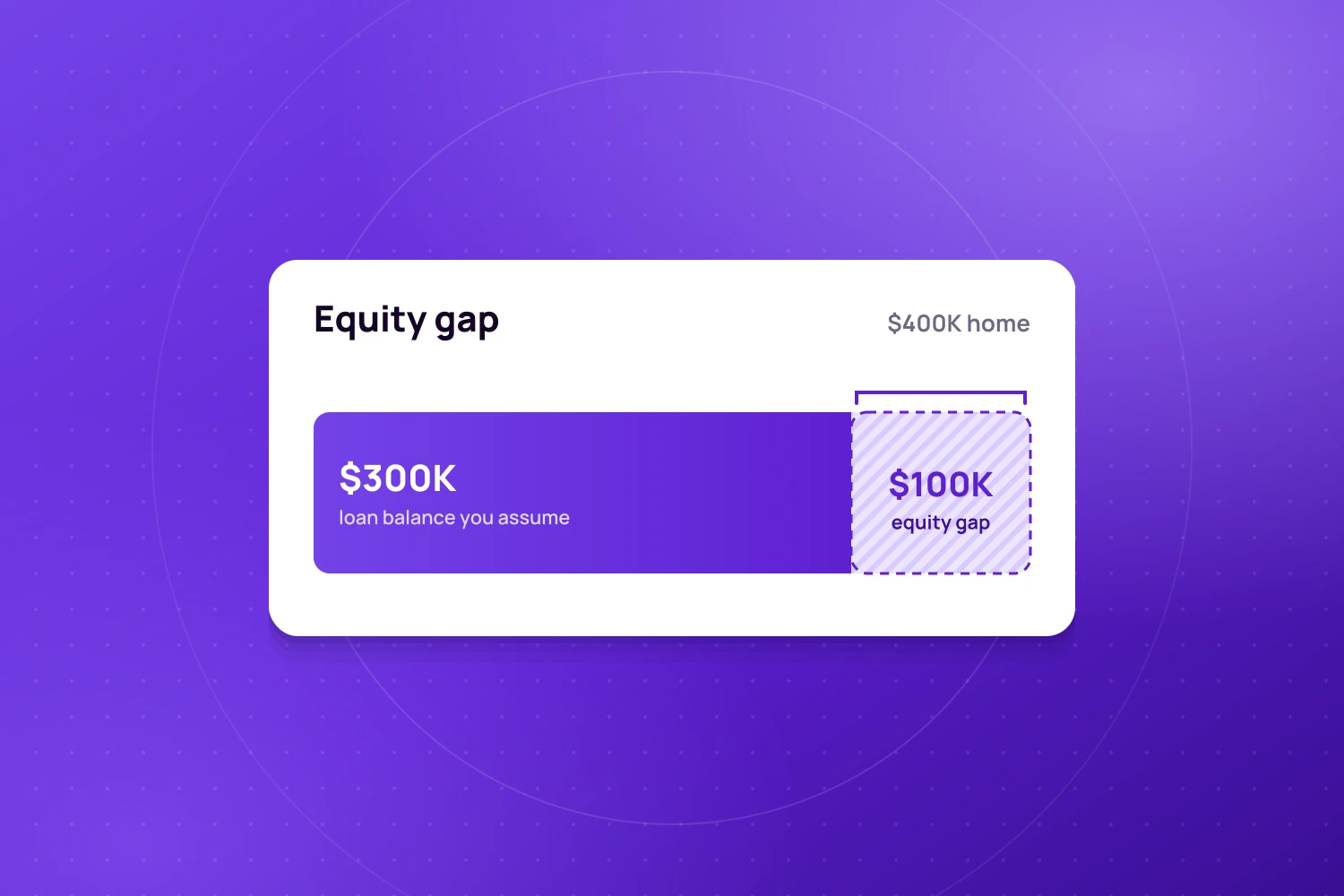
The equity gap is the difference between the home's purchase price and the remaining loan balance. It is the amount the buyer owes the seller outside the assumed mortgage. In a market where home values have appreciated significantly since 2020 and 2021 originations, this gap is the biggest practical barrier to assumption.
A Worked Example
A home is listed at $400,000. The seller's remaining USDA loan balance is $280,000, originated at 3.0% in 2021 with 25 years remaining.
- Assumed loan: $280,000 at 3.0%, monthly P&I ≈ $1,328
- Equity gap: $120,000
Option A (Cash): Pay $120,000 at closing. Monthly payment: $1,328. Cleanest option, but requires significant liquid assets. Most practical for buyers downsizing or selling another property.
Option B (Second mortgage at 7.5%): Borrow $120,000 for 20 years at 7.5%. Monthly payment on the second lien: approximately $967. Total monthly: $1,328 + $967 = $2,295. Not all servicers offer assumption gap financing. Buyers should shop specifically for it. USDA may also approve a supplemental guaranteed loan when additional financing is needed to complete the assumption.
Option C (Seller financing): The seller carries the note on the equity portion. Terms are negotiated directly, with no bank involvement on the second. Works when the seller does not need equity in cash immediately, which is common in family or off-market transactions.
The Blended Rate Still Wins
Comparison: A new first mortgage of $400,000 at 7.28% for 30 years carries a monthly P&I of approximately $2,737. Even Option B, with a second mortgage at 7.5%, totals $2,295 per month. That is $442 less per month, or about $5,300 per year in savings.
Buyers working with lenders and credit unions experienced in assumption gap financing will find more flexible options than those working with servicers unfamiliar with the process.
The USDA Loan Assumption Process, Step by Step
USDA assumptions require approval from both the loan servicer and the USDA Rural Development office. That two-party requirement is what makes the timeline longer and less predictable than a standard purchase. Expect 45 to 90 days, with some cases extending to 120 or more.
- Verify the loan is assumable (Days 1 to 3). Confirm with the seller or their agent that the existing mortgage is a USDA loan. Request the servicer's name, current balance, interest rate, and remaining term.
- Request a formal assumption packet (Days 3 to 7). Contact the servicer directly and ask for assumption application materials. Be prepared to reference HB-1-3555, Chapter 17 if the servicer is unfamiliar with USDA assumptions.
- Submit your application and documentation (Days 7 to 21). Provide proof of income (W-2s, tax returns, pay stubs), bank statements, credit authorization, government-issued ID, and proof of residency intent. Gather income documentation for all household members aged 18 and older.
- Lender underwriting (Days 21 to 45). The servicer evaluates your credit, income, DTI, and occupancy intent against USDA standards. Appraisal requirements vary by servicer.
- USDA Agency approval (Days 45 to 75). The servicer submits the file to USDA for agency-level approval. Processing times depend on the local Rural Development office workload. This step has the most variability.
- Close (Days 75 to 90+). Sign the assumption agreement, pay fees, and the loan transfers to your name. On a USDA Guaranteed loan, the seller remains personally liable on the original note.
The servicer competency gap is real. Not all servicers handle USDA assumptions frequently, and some have no institutional knowledge of the procedures. Buyers who work with lenders or credit unions experienced in USDA lending will move faster through every step.
What Does It Cost to Assume a USDA Loan?
Assumption is not free. The cost stack is smaller than a full origination, but buyers should account for every line item before committing.
On a $280,000 remaining balance, the upfront guarantee fee at 1% is $2,800. Combined with servicer, title, and attorney costs, total assumption closing costs typically range from $4,000 to $7,500. Compare that to the roughly $8,550 annual payment savings from assuming a 3.15% rate versus originating at 7.28%. The math resolves quickly.
Key Takeaways
USDA loan assumption is a federally authorized, regulation-backed strategy that can save qualified buyers hundreds of dollars per month on homes in USDA-eligible areas, which cover 97% of U.S. land. The process takes 45 to 90 days, requires full qualification for arm's-length buyers, and demands upfront planning for the equity gap. Family transfers are simpler still: the original rate and terms carry over without a new eligibility review.
- Verify the seller's loan type, balance, and rate before making an offer.
- Run the blended-rate math if you need equity gap financing. It almost always beats a new first mortgage.
- Work with a servicer or lender who has processed USDA assumptions before. Institutional knowledge directly impacts your timeline.
- Check your household income against USDA county limits early. Count every adult aged 18 and older.
Browse current assumable mortgage listings on Assumable.io, or review related guides on FHA and VA loan assumptions to compare your options across all federally backed programs.