.svg)

How to Transfer a Mortgage to Another Person: 2024 Legal Guide + $100K Savings
How to transfer a mortgage to another person through loan assumption, including family and divorce transfers protected by the Garn-St. Germain Act.
Key takeaways
How to Transfer a Mortgage to Another Person: Family Transfers, Divorce & More
Executive Summary
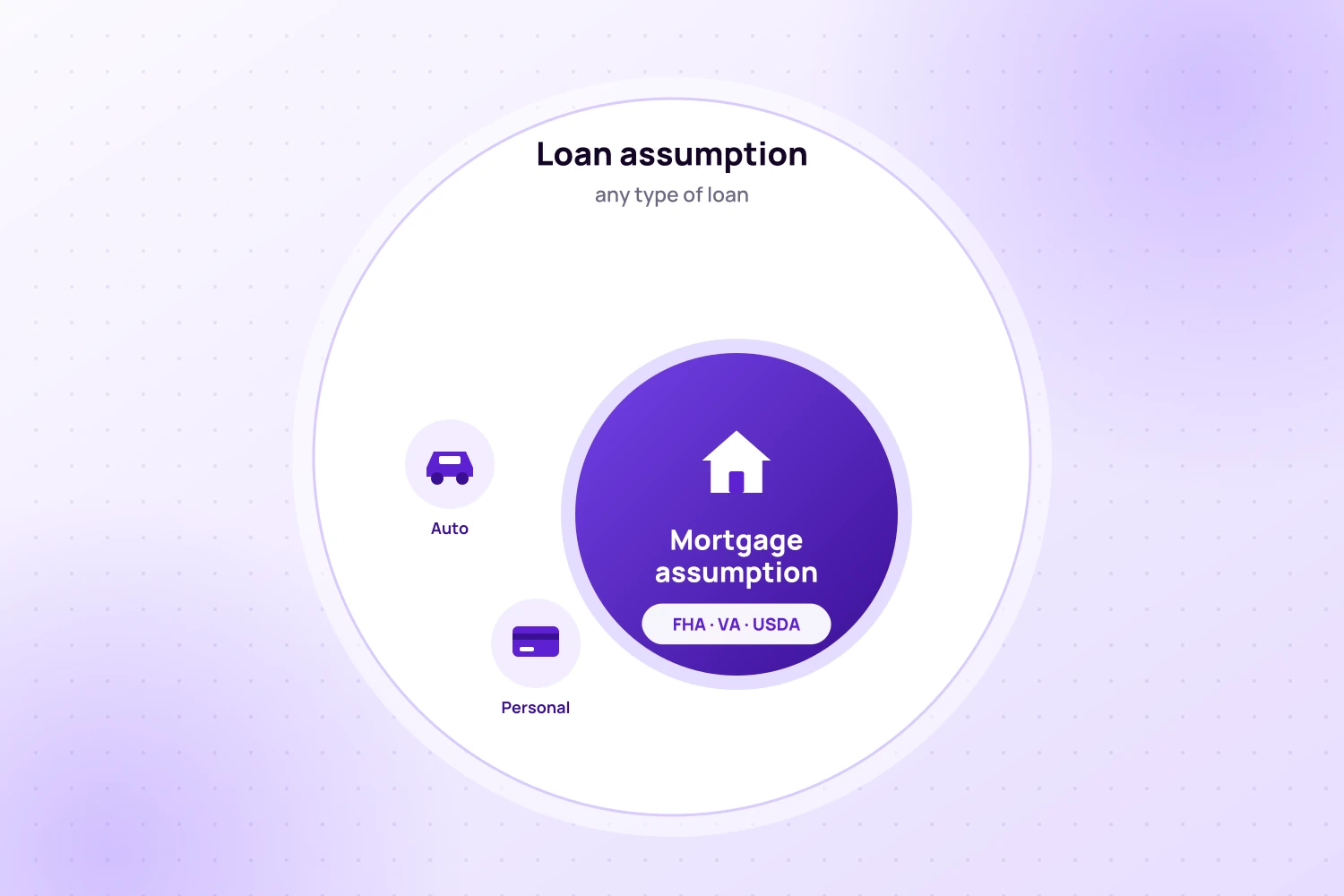
- Direct answer: Yes, you can transfer a mortgage to another person through a legal process called loan assumption. Government-backed loans (FHA, VA, USDA) are assumable with lender approval, and the Garn-St. Germain Act of 1982 provides federal protections for family and divorce transfers, even on some conventional loans.
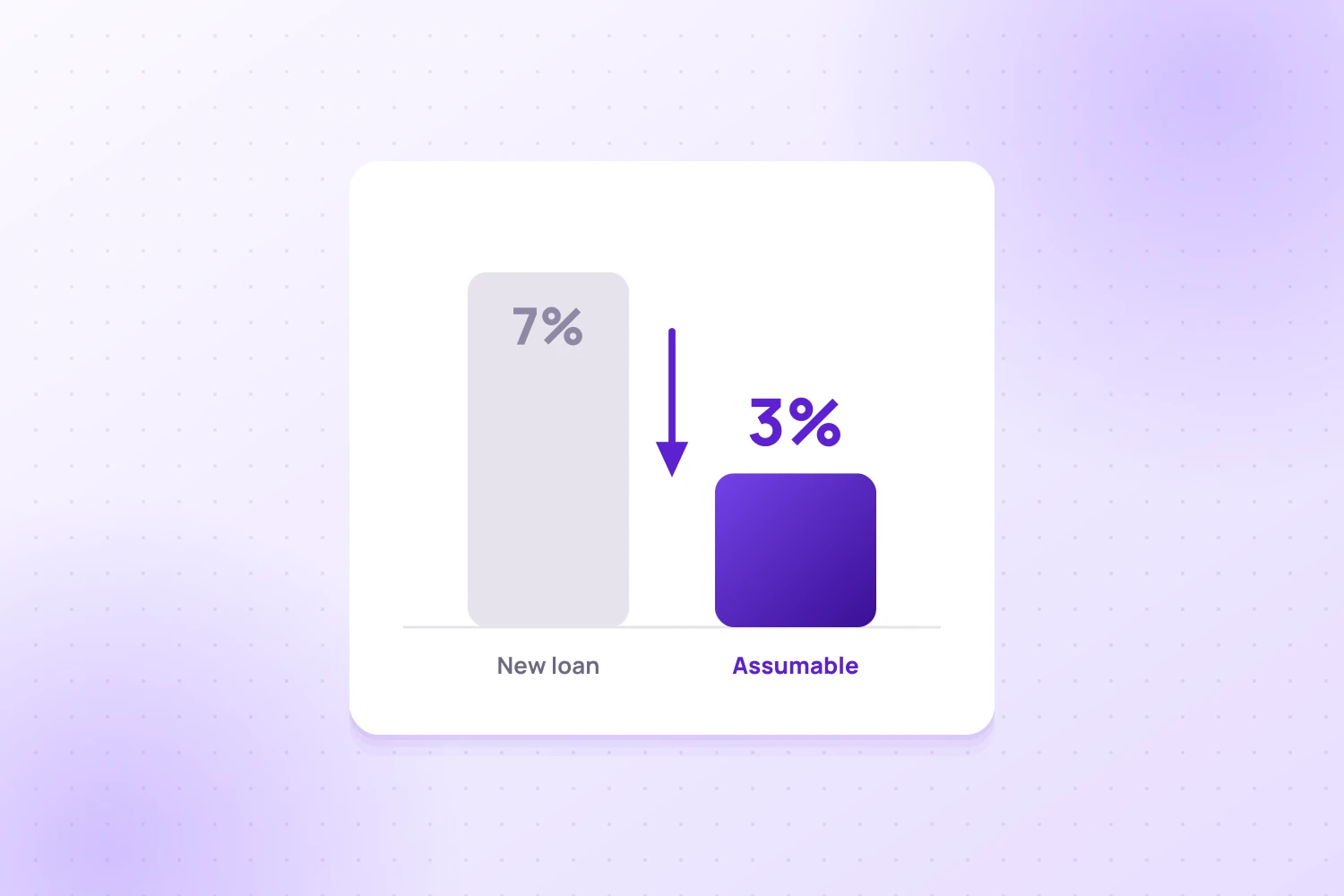
- Key insight: With the average existing mortgage rate at 4.4% and new mortgages averaging around 6%, keeping a low-rate loan through assumption instead of refinancing saves hundreds of dollars per month. On a $350,000 mortgage, the difference can exceed $100,000 in lifetime interest.
- Assumable.io perspective: Most homeowners confuse transferring a deed with transferring a mortgage. They are two entirely different legal actions. This guide breaks down the exact process, costs, and federal protections for every transfer scenario, backed by specific statute citations and real financial math.
- Actionable takeaway: Identify your loan type (FHA, VA, USDA, or conventional), determine which Garn-St. Germain exception applies to your situation, then contact your loan servicer to request the assumption application packet. Use the Assumable Mortgage Calculator to compare your savings before making a move.
Thousands of homeowners search for "can you transfer a mortgage to another person" every month. The answer is yes, but almost none of them realize the mechanism is called loan assumption, or that a 1982 federal law specifically protects family and divorce transfers. If you're going through a divorce, inheriting a home, or trying to keep a family property without refinancing at today's rates, this guide walks through every legal scenario with the exact process, costs, and federal protections you need to know.
Can You Transfer a Mortgage to Another Person?
Yes, a mortgage can be transferred to another person through a process called loan assumption. But here's the confusion that trips up nearly everyone: transferring property ownership (the deed) and transferring the mortgage obligation are two completely different legal actions.
Deed Transfer vs. Mortgage Transfer
Signing a quitclaim deed does not remove anyone from the mortgage. The lender doesn't care what the deed says. They care who signed the promissory note. You can hand someone the deed to your house tomorrow, and you'll still owe every remaining payment on the loan.
This distinction is the single biggest source of costly mistakes in family transfers and divorce settlements.
The Due-on-Sale Clause
Most mortgages include a due-on-sale clause, a provision that lets the lender demand full repayment if ownership changes hands. In plain terms: the lender can call the entire loan due if you transfer the property without their permission.
That sounds like a dead end. It isn't. Two major exceptions make mortgage transfers possible:
- Government-backed loans (FHA, VA, USDA) are assumable by design. These loan programs were built to allow transfers with lender approval.
- The Garn-St. Germain Act of 1982 carves out specific family and divorce exceptions that override due-on-sale clauses, even on conventional loans.
Why Mortgage Transfers Matter Right Now
The rate environment makes this more than a legal question. It's a financial one. 20% of all outstanding mortgages carry rates below 3%, according to the Bipartisan Policy Center. The average existing mortgage rate sits at 4.4%. New mortgages? Around 6%.
Keeping an existing low-rate loan through assumption instead of refinancing into a new one saves real money. Often hundreds of dollars per month. Mortgage assumptions grew 139% from 2022 to 2023, reaching roughly 6,000 assumptions that year. This is a growing trend, not a fringe strategy.
The most common mortgage transfer scenarios involve family: a parent passing property to a child, spouses adjusting ownership, or heirs inheriting a home. Federal law has specific protections for each of these.
Transferring a Mortgage to a Family Member
The legal framework for family mortgage transfers is stronger than most people realize. A federal statute, cited by its formal designation as 12 U.S.C. §1701j-3, lists nine specific situations where lenders cannot enforce due-on-sale clauses. Four of them directly protect families.
What the Garn-St. Germain Act Protects
The Garn-St. Germain Depository Institutions Act of 1982 prevents lenders from calling a loan due in these family scenarios:
- Transfers between spouses
- Transfers from parents to children
- Transfers upon the death of the borrower (to a relative who inherits)
- Transfers into a revocable living trust where the borrower remains the beneficiary
These protections apply to residential property with fewer than five dwelling units. They override due-on-sale clauses on FHA, VA, USDA, and conventional loans alike.
Transfers Between Spouses and to Children
A parent can transfer a mortgaged property to their child, during life or at death, and the lender cannot accelerate the loan. Per 12 U.S.C. §1701j-3(d)(6), this protection is explicit. Spouse-to-spouse transfers carry the same protection.
But there's a critical limitation that almost no one mentions: the law protects parent-to-child transfers but does NOT protect child-to-parent transfers. If you're a child trying to transfer a mortgaged property back to your parent, the due-on-sale clause remains enforceable. This one-way limitation catches families off guard and can derail estate planning if not identified early.
Transfers Upon Death (Inheritance)
When a borrower dies and a relative inherits the home (by will, trust, or intestacy), the lender cannot enforce the due-on-sale clause. The heir can continue making payments under the original mortgage terms: same rate, same payment schedule.
The heir does not need to formally assume the loan to keep paying. But a formal assumption gives them legal standing, clean title, and access to the servicer's account. Without it, practical issues like requesting payoff statements or modifying insurance can become unnecessarily difficult.
Transfers into Revocable Living Trusts
Property owners can transfer real estate into a revocable living trust without triggering the due-on-sale clause, provided the borrower remains the trust's beneficiary. This is a common estate planning move, and the Garn-St. Germain Act explicitly protects it.
Of all the family scenarios, divorce is the most complex and the most financially consequential. A divorce decree might say who gets the house, but it doesn't say a word to your lender.
Mortgage Assumption in Divorce
Divorce is where the gap between what people think happens and what actually happens with a mortgage is widest. Understanding this gap can protect your credit, your finances, and your housing stability.
A Divorce Decree Doesn't Release You From the Mortgage
A divorce decree or settlement agreement can assign mortgage responsibility to one spouse. But the lender is not a party to the divorce. Both names stay on the mortgage, and both credit reports, until the loan is formally assumed or refinanced.
This is the number one mistake divorcing couples make. The spouse who "gave up" the house is still liable if payments are missed. A single late payment during the transition hits both credit scores, regardless of what the divorce decree says.
If you're reading this and already in that situation, you're not alone. But you need to take action beyond what the court ordered.
Assumption vs. Refinance: When Each Makes Sense
Here's where the math tells the story. Take a $350,000 mortgage originated in 2021 at 3.25% with 25 years remaining.
- Assumption keeps that 3.25% rate. Monthly principal and interest: approximately $1,524.
- Refinancing at today's roughly 6% rate on a new 30-year term: approximately $2,098/month.
- Monthly savings from assumption: $574. Annual savings: $6,888. Lifetime interest savings: over $100,000.
As divorce mediation attorney Julia Rueschemeyer told U.S. News: "In the current mortgage interest environment... it is nearly always better to assume the mortgage rather than refinance."
But assumption has a real limitation. It doesn't let you borrow against equity for a buyout. If one spouse needs to buy out the other's equity share, they'll need separate financing: a second mortgage, HELOC, or other gap financing. Refinancing rolls the buyout into one transaction, which is simpler even though it costs more.
FactorLoan AssumptionRefinancingInterest RateKeeps original (e.g., 3.25%)Today's rate (~6%)Monthly P&I ($350K example)~$1,524~$2,098Monthly Savings~$574—Closing Costs0.5%–1% of balance2%–5% of loan amountEquity BuyoutRequires separate financingCan be rolled into loanProcessing Time30–120 days30–60 daysReleases Original BorrowerYes (upon completion)Yes (upon completion)
FHA and VA Assumptions in Divorce
FHA loans: The maximum processing fee for an FHA assumption is $1,800, updated in August 2024 per FHA Handbook 4000.1 (doubled from the previous $900 cap). One obligation the assuming spouse inherits: if the FHA loan was originated after July 3, 2013, annual mortgage insurance premium (MIP) stays for the life of the loan, unless the original down payment was 10% or more.
VA loans: The assuming spouse pays a 0.5% VA funding fee. But the critical nuance most content overlooks involves VA entitlement. If a civilian ex-spouse assumes the VA loan, the veteran's entitlement stays tied to that property and is not restored. The veteran cannot use that entitlement to buy another home with a VA loan until the assumed loan is paid off. Entitlement is only restored if the assuming ex-spouse is also a veteran (substitution of entitlement) or the loan is paid in full.
For situations where the veteran is keeping the home and the non-veteran spouse simply needs to be released from liability, the VA offers a simplified spousal release process per VA Circular 26-23-10. This doesn't require a full assumption.
Given that 74% of VA homeowners carry rates below 5% (per Ginnie Mae data), assumption is especially valuable for military families. The rate savings are significant, and understanding the entitlement implications is essential before choosing a path forward.
Protecting Your Credit During the Transition
The assumption process takes 30 to 90 days. Sometimes 90 to 120 days due to servicer backlogs. During that window, both parties remain on the mortgage.
Both spouses should ensure payments are made on time throughout. The divorce settlement should include specific language about who pays during the assumption process and consequences for non-payment. A Certified Divorce Lending Professional (CDLP) can help structure these provisions.
Timing: When You Can Start
The assumption process cannot begin until the divorce is final. A signed settlement or separation agreement is not sufficient. Plan for the full timeline: divorce finalization plus 30 to 120 days for assumption processing.
Whether your transfer involves divorce, inheritance, or another family scenario, the mechanics of the assumption process follow a similar path. Here's what to expect, step by step.
How the Transfer/Assumption Process Works
The assumption process involves five core steps. Timelines and requirements vary by loan type, but the sequence is consistent.
Step 1: Contact Your Loan Servicer
Call the servicer (the company currently handling your payments, not necessarily the original lender). Ask specifically about assumption eligibility and request the assumption application packet. Many servicers are unfamiliar with assumptions or under-resourced for them. Be persistent. Ask for the "loss mitigation" or "transfer" department if the front-line agent doesn't know.
Step 2: Submit the Assumption Application
The new borrower (the person taking over the loan) fills out the application. It's similar to a standard loan application: personal information, employment history, income, and assets. For divorce scenarios, include the final divorce decree or settlement agreement.
Step 3: Provide Financial Documentation
You'll need pay stubs, tax returns, bank statements, and proof of assets. The lender must verify the new borrower can independently support the payments. For VA loan assumptions, the assuming borrower provides a Certificate of Eligibility (COE) if they're a veteran. If civilian, that step is skipped, but the entitlement implications described above still apply.
Step 4: Credit and Income Review
The servicer evaluates the new borrower's creditworthiness. FHA and VA have their own minimum requirements (generally more flexible than conventional). This step is where delays happen most often. Servicers have limited staff dedicated to assumptions, and the financial incentive for them to process these quickly is minimal.
Step 5: Close the Assumption
Assumption closing resembles a simplified home closing. Sign documents, pay fees, and the loan transfers to the new borrower.
Cost TypeAssumptionRefinancingGeneral assumption fees0.5%–1% of loan balance ($1,750–$3,500 on $350K)N/AFlat fees (some lenders)$500–$1,500N/AFHA processing feeMax $1,800N/AVA funding fee0.5% of balanceN/ARefinancing closing costsN/A2%–5% of loan amount ($7,000–$17,500 on $350K)VA-specific comparison$2,000–$4,000$8,000–$12,000 for new VA purchase
Realistic Timelines
Typical assumption processing takes 30 to 90 days. The reality? Many servicers take 90 to 120 days due to understaffing. The VA has mandated 45-day processing via Circular 26-23-27, but as NPR reported in February 2026: "by law, servicers have 45 days to evaluate the buyer's credit, though the reality is it can take months."
This is why having the right tools and information matters. The process works. It requires patience and preparation. Use the Assumable Mortgage Calculator to compare assumption costs and savings for your specific loan before you start.
Not every mortgage can be assumed. If your loan is a conventional mortgage without a qualifying exception, here are your alternatives.
When You Can't Transfer: Alternatives
Assumption isn't always an option. Being honest about that is the only way to give you a complete picture.
The Conventional Loan Reality
Conventional loans (not backed by FHA, VA, or USDA) are generally not assumable. The due-on-sale clause is enforceable, and the lender can demand full repayment upon transfer.
The exception: even for conventional loans, the Garn-St. Germain Act's family and divorce exceptions still apply. If you're transferring to a spouse, to a child, or as part of a divorce decree, the lender cannot accelerate the loan. But if you're trying to transfer a conventional loan to a non-family buyer? That's not happening.
Refinancing Into the New Borrower's Name
The most common alternative. The new borrower applies for a brand-new mortgage, pays off the existing one, and takes over ownership. The downside is you lose the original rate. On that $350K running example, moving from 3.25% to 6% adds $574 per month, or $6,888 per year. The upside: cleaner process, faster timelines, and the ability to roll an equity buyout into the new loan.
Selling and Purchasing New
Sometimes the cleanest option. Sell the property, split proceeds per the agreement or settlement, and each party starts fresh. This makes sense in divorce when neither party can qualify to assume alone, or when the equity split is too contentious to resolve through assumption.
Subject-To and Wraparound Mortgages
These are investor strategies where a buyer takes over payments without formally assuming the loan. The original loan stays in the seller's name. They carry real risk: the due-on-sale clause remains enforceable, and the original borrower has no control over whether payments are made. Mentioned here for completeness, but these are workarounds, not legitimate transfer mechanisms.
For the millions of FHA, VA, and USDA loans that are assumable, the challenge isn't legality. It's finding them and running the numbers.
How Assumable.io Helps
For homebuyers (non-family scenarios): Assumable.io is the only nationwide search engine dedicated to assumable mortgages, covering FHA, VA, and USDA loans across all 50 states and thousands of cities. Search for homes with existing low-rate loans you can assume.
For family and divorce scenarios: The Assumable Mortgage Calculator lets you model whether assumption saves you money versus refinancing. Plug in your existing loan terms, compare against current rates, and see the monthly and lifetime savings before you commit.
For agents and advisors: Real estate agents, divorce attorneys, and financial advisors can use the platform to better serve clients navigating these transitions. Assumable.io provides the data, education, and tools to make assumption a viable strategy, not just a theoretical one.
Key Takeaways
Mortgage transfers are real, legal, and increasingly common. The mechanism is loan assumption. The legal foundation is the Garn-St. Germain Act of 1982. And the financial case, in a rate environment where existing mortgages average 4.4% and new ones cost 6%, is often overwhelming.
Whether you're transferring to a family member, sorting out a mortgage after divorce, or inheriting a home, the process follows a clear path: confirm your loan type, identify your legal protection, contact your servicer, and work through the assumption. The math speaks for itself: $574 per month, $6,888 per year, $100,000+ over the life of the loan.
Estimate your savings with the Assumable Mortgage Calculator, or search assumable homes in your area to see what's available.
Frequently Asked Questions
Can you transfer a mortgage to another person?
Yes. A mortgage can be transferred to another person through a process called loan assumption. Government-backed loans (FHA, VA, USDA) are assumable with lender approval. For family transfers and divorce, the Garn-St. Germain Act of 1982 provides federal exceptions that prevent lenders from enforcing due-on-sale clauses, even on some conventional loans. The new borrower must qualify with the lender based on creditworthiness and income.
Can you transfer a mortgage to a family member?
Yes. Under the Garn-St. Germain Act of 1982 (12 U.S.C. §1701j-3), lenders cannot enforce due-on-sale clauses on transfers between spouses, transfers from parents to children, transfers upon a borrower's death, and transfers into revocable living trusts. These protections apply to residential property with fewer than five units. Note that the law protects parent-to-child transfers but not child-to-parent transfers.
What is the Garn-St. Germain Act?
The Garn-St. Germain Depository Institutions Act of 1982 is a federal law that allows lenders to enforce due-on-sale clauses but lists nine specific exceptions where they cannot. The most relevant exceptions protect transfers between spouses, transfers to children, transfers upon death of the borrower, transfers into revocable trusts, and transfers resulting from divorce.
Does a divorce decree remove you from a mortgage?
No. A divorce decree can assign mortgage responsibility to one spouse, but it does not remove the other spouse from the loan. Both parties remain liable to the lender until the mortgage is formally assumed or refinanced. Missing payments will affect both spouses' credit scores regardless of what the divorce decree says.
Can I assume my spouse's mortgage after divorce?
Yes. The Garn-St. Germain Act protects mortgage transfers resulting from divorce, preventing lenders from enforcing due-on-sale clauses. The spouse keeping the home must qualify for the assumption based on their own creditworthiness and income. The process cannot begin until the divorce is finalized.
What happens to a VA loan after divorce?
In a divorce, either spouse can assume a VA loan. However, if a civilian ex-spouse assumes the loan, the veteran's VA entitlement remains tied to that property and is not restored until the loan is paid off. The VA offers a simplified spousal release process (per VA Circular 26-23-10) when the veteran is keeping the home and the non-veteran spouse needs to be removed from liability.
How much does it cost to assume a mortgage?
Assumption fees typically range from 0.5% to 1% of the remaining loan balance. Some lenders charge flat fees between $500 and $1,500. FHA caps its processing fee at $1,800. VA loans carry a 0.5% funding fee. By comparison, refinancing closing costs range from 2% to 5% of the loan amount, often two to five times more expensive than an assumption.
How long does a mortgage assumption take?
A mortgage assumption typically takes 30 to 90 days, though servicer backlogs often extend the process to 90 to 120 days. The VA has mandated a 45-day processing timeline, but actual timelines frequently exceed that. Planning for 60 to 120 days from application to closing is realistic.
Can you assume a conventional mortgage?
Generally, no. Conventional mortgages that are not backed by a government agency (FHA, VA, or USDA) include enforceable due-on-sale clauses that prevent assumption. However, the Garn-St. Germain Act provides exceptions for transfers between spouses, transfers to children, and transfers resulting from divorce, even on conventional loans.